QR Codes for Healthcare: Patient Safety, Efficiency & Privacy
In a hospital or clinic setting, speed and precision save lives. A medication error, a misidentified patient, or a lost piece of equipment can have catastrophic consequences. The healthcare industry has rapidly adopted QR code technology to eliminate manual data-entry errors, accelerate workflows, and provide contactless information access in infection-sensitive environments. This guide explores the most impactful healthcare applications—and the non-negotiable privacy requirements that come with them.
Why QR Codes Are Transforming Healthcare
The World Health Organization has identified medication errors as a leading cause of preventable harm in healthcare, costing billions annually. A significant portion of those errors stem from human transcription mistakes—nurses misreading handwriting, pharmacists entering a dosage incorrectly, or patients being given another person's medication. QR codes create an immutable, instant link between a physical object (a wristband, a medication bottle, a piece of equipment) and a digital record, making it nearly impossible to confuse one patient or drug for another.
Beyond safety, QR codes dramatically speed up administrative processes. Check-in forms that once took 15 minutes of clipboard-filling can be completed on a patient's own phone in under 3 minutes. This reduces front-desk congestion, lowers infection risk from shared surfaces, and allows clinical staff to focus on care rather than paperwork.
Core Healthcare Applications
1. Patient Identification Wristbands
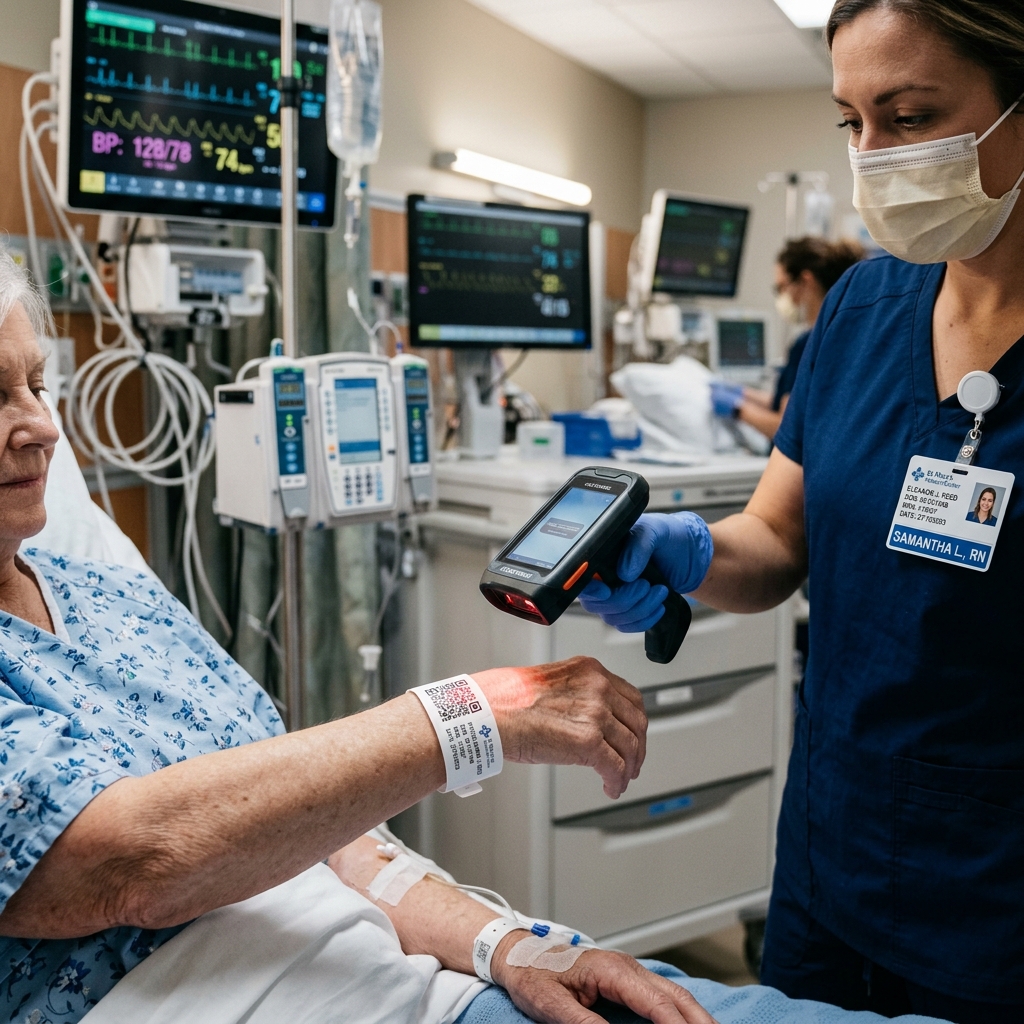
The most critical first step in any treatment is confirming the correct patient. Modern hospitals print QR codes on patient wristbands that, when scanned, instantly surface the patient's electronic health record (EHR) on a nurse's mobile device. The QR code itself contains no health data—it serves as an encrypted token that authenticates against the secure internal database. This approach is dramatically safer than relying on verbal confirmation or manually cross-referencing paper charts, especially in high-pressure emergency situations.
2. Medication Administration Safety
The "Five Rights" of medication administration—right patient, right drug, right dose, right route, right time—can be verified automatically using QR codes. Nurses scan the code on a medication bottle, then immediately scan the patient's wristband QR code. The hospital's medication management software cross-references both scans against the physician's order in real time. If there is any discrepancy, an alert immediately flags the issue before any medication is administered. Hospitals implementing barcode medication administration (BCMA) systems based on this workflow have reported dramatic reductions in medication errors.
3. Medical Equipment Tracking and Maintenance
Hospitals own thousands of pieces of mobile equipment—IV pumps, wheelchairs, defibrillators, portable ventilators. Finding the right device during an emergency can be genuinely life-threatening if the search takes too long. By affixing a QR code to every piece of equipment, staff can update the device's location in a central asset management system with a single scan. The same code can surface the device's maintenance history, last cleaning date, and scheduled service intervals, ensuring that critical equipment is always ready when needed.
4. Contactless Patient Check-In
The COVID-19 pandemic permanently accelerated the adoption of touchless workflows in healthcare settings. Waiting room QR codes now allow patients to complete demographic forms, health history questionnaires, insurance verification, and consent documents entirely on their own device before being called to a room. This eliminates shared pens and clipboards, reduces front desk bottlenecks, and allows clinical staff to review intake information before the patient even enters the exam room, making appointments significantly more efficient.
5. Discharge Instructions and Medication Guides
Discharge compliance is one of healthcare's most persistent challenges. Patients given a stack of paper instructions often don't read them, can't understand complex medical language, or lose the paperwork entirely. A QR code on the discharge summary can link to a plain-language video walkthrough of the patient's post-care instructions, a list of warning signs to watch for, and a direct link to schedule a follow-up appointment. Studies on QR-enhanced discharge instructions show improved patient understanding and reduced 30-day readmission rates.
Patient Security & Privacy First
As a Director of Information Systems, the primary concern is data privacy. linksqrcode.com's browser-only generation ensures that sensitive patient data or medication links never touch a 3rd party server. Healthcare providers can generate high-utility codes for administrative efficiency while maintaining the highest standards of HIPAA-aligned data sovereignty.
6. Lab Specimen Tracking
In clinical laboratories, a mislabeled specimen can lead to incorrect diagnoses, inappropriate treatments, and significant patient harm. QR codes on specimen tubes allow lab technicians to instantly verify the patient, the test ordered, the collection time, and the handling requirements before processing begins. The chain of custody for every sample can be tracked from collection to result, providing a complete audit trail that is invaluable both for patient safety and regulatory compliance.
HIPAA Compliance: Non-Negotiable Rules
Healthcare professionals must approach QR code implementation with a clear understanding of the Health Insurance Portability and Accountability Act (HIPAA). The core principle is straightforward: Protected Health Information (PHI) must never be directly encoded into a publicly accessible QR code.
- Never Embed PHI Directly: A QR code should function as an authentication token or a pointer to a secure system, not as a container for sensitive data. Anyone who scans an exposed QR code in a hallway should not be able to access a patient's records.
- Use Secure, Authenticated Portals: All patient-facing QR codes should link to HIPAA-compliant patient portals that require login credentials before any health information is displayed.
- Use Privacy-Safe Generators: Our tool is ideal for healthcare's internal use cases because it runs 100% locally in the browser. No URL, no code data, and no patient reference entered into our generator is ever transmitted to or stored on any external server.
- Audit and Document: Maintain documentation of all QR code deployments, the systems they link to, and the access controls protecting those systems, as part of your standard HIPAA security documentation.
HIPAA-Friendly, Browser-Based QR Generation
Our generator produces QR codes entirely within your browser. No data is uploaded to our servers, making it a privacy-safe choice for healthcare professionals generating codes for internal reference links and contact information.
Generate Securely →